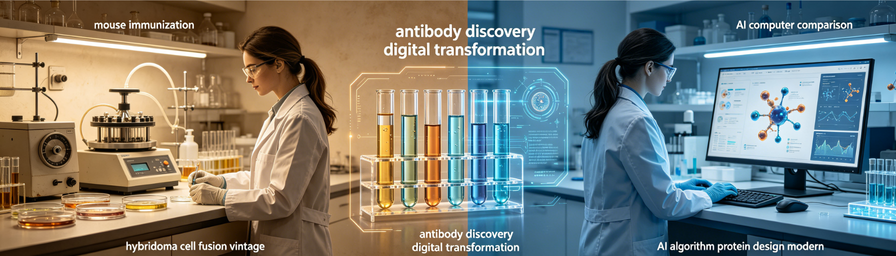
Antibody discovery sits at a crossroads. For six decades, hybridoma technology has been the gold standard. Now, AI-powered antibody design is challenging that dominance — not through hype, but through measurable improvements in speed, cost, and the range of tractable targets. This article provides a direct, data-grounded comparison of both approaches.
Hybridoma technology, developed by Köhler and Milstein in 1975 (Nobel Prize, 1984), works by immunizing an animal (typically mouse or rat) with the target antigen, harvesting antigen-specific B cells from the spleen, fusing them with immortalized myeloma cells to create hybridomas, and screening for clones secreting high-affinity antibodies.
The elegance of hybridoma lies in leveraging billions of years of immune system evolution. The animal's immune response performs a natural affinity maturation process, producing antibodies with single-digit nanomolar affinities after weeks of in vivo selection. The resulting antibodies are naturally optimized for binding and — for mouse antibodies at least — are relatively stable and expressible.
AI antibody design replaces biological immune responses with computational inference. Large language models (LLMs) trained on millions of antibody sequences and structures learn the underlying rules that govern antibody-antigen recognition. These models can generate, evaluate, and optimize antibody sequences in silico — exploring a vastly larger sequence space than any animal immune system could.
AntibodyLLM's platform uses domain-specific models trained on curated antibody datasets with experimentally validated binding and developability annotations. This goes beyond generic protein language models: our AI understands antibody-specific features including CDR loop geometry, framework-CDR interactions, and the relationship between sequence variation and biophysical properties.
| Dimension | Hybridoma | AI Design (AntibodyLLM) |
|---|---|---|
| Timeline | 6–18 months | 4–8 weeks |
| Cost per validated lead | $150K–500K+ | $30K–120K |
| Animal use | Required (mice/rats) | None required |
| Membrane protein targets | Very difficult | Standard workflow |
| Developability screening | Post-discovery (late, expensive) | In silico before synthesis |
| Affinity range | 1–50 nM (naturally matured) | 0.1–100 nM (AI-optimized) |
Despite AI's advantages, hybridoma retains genuine strengths in specific scenarios:
The most sophisticated programs no longer choose between AI and experimental discovery — they combine them. AI generates and pre-screens candidates computationally; phage display or single B-cell isolation provides experimental diversity; AI integrates binding data to select the optimal leads; AI affinity maturation optimizes the winners. This synergistic pipeline captures the speed and target coverage of AI with the natural diversity of experimental approaches.
At AntibodyLLM, our AI antibody design service is built for exactly this integration — delivering validated leads faster while maintaining the experimental rigor that clinical development demands.
Choose AI antibody design when: timeline is critical, your target is a membrane protein or difficult antigen, you need bispecific formats, or you want to minimize animal use. Choose hybridoma when: you need functional selection during discovery, your target is a complex native protein, or panel breadth across multiple epitopes is the priority. For most modern antibody programs, the answer is: start with AI, validate experimentally, and iterate with AI again.
The field is converging on AI as the default starting point — not because it replaces wet-lab work, but because it makes wet-lab work faster, cheaper, and more targeted. The question is no longer whether to adopt AI antibody design, but how to integrate it most effectively into your discovery pipeline.
Tell us your target and we'll demonstrate how our AI platform can deliver validated leads in 4–8 weeks.
Start Your AI Design Project