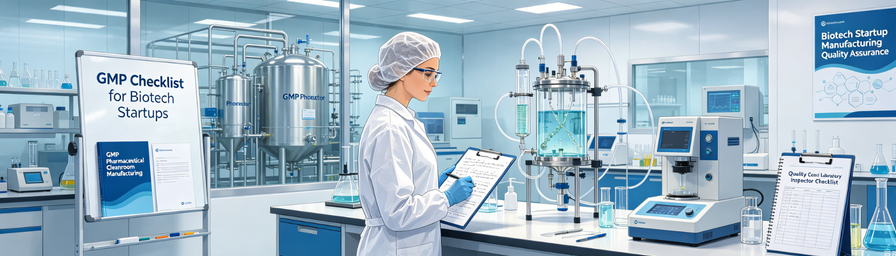
Biopharmaceutical Manufacturing GMP Checklist for Biotech Startups
For a biotech startup advancing an antibody into clinical trials, selecting the right GMP manufacturing partner is one of the highest-stakes decisions in your development program. A failed batch, a regulatory inspection observation, or a manufacturing hold can delay your IND by 6–18 months and cost millions of dollars. This checklist gives you the framework to evaluate CRO partners rigorously — before you sign the contract.
Why GMP Manufacturing Is Different
Good Manufacturing Practice (GMP) is not simply a quality label — it is a comprehensive regulatory framework that governs every aspect of pharmaceutical manufacturing. FDA 21 CFR Parts 210 and 211, EMA GMP Guidelines, and ICH Q7, Q9, and Q10 collectively define requirements for:
Facility design, qualification, and environmental monitoring
Equipment qualification (IQ/OQ/PQ) and calibration
Raw material qualification and supplier qualification
Process validation with pre-defined acceptance criteria
Validated analytical methods with full method validation data
Batch manufacturing records (BMR) documenting every step
Independent quality control (QC) review and lot release
Deviation management, CAPA systems, and change control
Record retention and readiness for regulatory inspection
Every vial of antibody drug substance administered to a human in a clinical trial must be traceable to a GMP batch record, released by a qualified person (QP in EU) against defined specifications, and manufacturable at a facility with a demonstrated GMP compliance history.
The Complete GMP Readiness Checklist
Section 1: Facility and Regulatory Compliance
GMP facility inspection history: Has the facility been inspected by FDA (BLA/IND inspection), EMA, or PMDA? What was the outcome? Request the most recent inspection report or EIR summary.
No active warning letters or import alerts: Search FDA's warning letter database for the facility's registration number.
Drug Establishment Registration (DEA): Facility is registered with FDA under 21 CFR 207.
Environmental monitoring program: Classified cleanrooms (ISO 5–7) with documented viable and non-viable particle monitoring, alert and action limits, and trend analysis.
Containment classification: Biosafety Level 1 or 2 operations as appropriate for your program; biological safety cabinets and HVAC segregation documented.
Section 2: Quality System
Pharmaceutical Quality System (PQS): ICH Q10-compliant quality management system with documented SOPs, batch record templates, and change control procedures.
Deviation and CAPA system: Electronic or paper-based deviation reporting, root cause analysis protocol, and CAPA closure tracking.
Supplier qualification program: All critical raw materials (media, feeds, resins, consumables) sourced from qualified suppliers with CoA review and periodic audit.
Independent QC release: QC department separate from manufacturing, with authority to reject batches. Lot release against pre-defined specifications with QP signature (EU) or QA release (US).
Annual Product Review (APR) or Product Quality Review (PQR): Trend analysis of batch data, yield, and quality attributes performed annually.
Section 3: Cell Line and Upstream Process
GMP-compatible cell line: CHO or other expression host with ICH Q5D-compliant cell banking (MCB + WCB), identity testing, sterility, mycoplasma, and viral adventitious agent testing.
Validated cell thaw and expansion procedure: Documented SOP for WCB thaw, seed train expansion, and bioreactor inoculation, with acceptance criteria at each step.
Bioreactor capacity at required scale: Stainless steel or single-use bioreactors at the scale needed for your batch size, with calibrated probes (pH, DO, temperature) and validated control systems.
Validated fed-batch process: Process characterization data demonstrating consistent titer and product quality across multiple runs at GMP scale. Design of Experiments (DoE) study or proven platform process documentation.
In-process control (IPC) testing: Daily or per-shift measurements of glucose, lactate, viable cell density, and pH; defined IPC specifications and actions for out-of-specification results.
Section 4: Downstream Purification and Viral Safety
Protein A capture chromatography: Validated resin lifetime (cycles), dynamic binding capacity, and elution pool specifications. Low-pH viral inactivation step (typically pH 3.5, 60 min) with validated hold time and conditions.
Viral clearance validation: ≥4 log reduction demonstrated for model viruses at each clearance step (Protein A low-pH, AEX, nanofiltration). Viral clearance study conducted by a qualified independent laboratory per ICH Q5A.
Polishing steps validated: Ion exchange and/or HIC chromatography for aggregation and charge variant removal, with validated loading, wash, and elution conditions.
Ultrafiltration/diafiltration (UF/DF): Validated concentration and buffer exchange step with defined transmembrane pressure, flux, and diavolume specifications.
Bioburden and endotoxin control: 0.2 µm sterile filtration before final fill; endotoxin <1 EU/mg for IV administration; bioburden testing at harvest and post-downstream steps.
Section 5: Analytical Testing and Release
Validated release methods: Each lot release analytical method (protein concentration, purity by SEC, SDS-PAGE, charge variants, glycan profile, HCP, residual protein A, endotoxin, sterility) must have a validation report demonstrating accuracy, precision, linearity, specificity, and robustness per ICH Q2(R1).
In-house vs. outsourced testing: Understand which release tests are performed in-house vs. at a CRO. Outsourced tests add 2–4 weeks to lot release timelines and introduce supply chain risk. Preference for in-house analytics.
Reference standard establishment: Qualified reference standard for potency, identity, and analytical testing comparisons across batches.
Stability program: ICH Q1A-compliant real-time and accelerated stability studies for drug substance at −80°C (long-term), −20°C (intermediate), and 5°C (accelerated), with testing at defined time points.
Section 6: Regulatory Documentation Support
CMC section support for IND: CRO has experience preparing or contributing to the Chemistry, Manufacturing, and Controls (CMC) section of IND submissions, including process description, batch records summary, analytical methods summary, and specifications.
Type B meeting preparation: Ability to provide data packages and process descriptions for pre-IND or Type B CMC meetings with FDA.
Technology transfer documentation: Clear protocols and acceptance criteria for transferring your process to a second CRO if needed — avoiding single-source dependency.
Batch records available for inspection: All batch manufacturing records, raw material CoAs, equipment logs, and environmental monitoring records maintained and accessible for regulatory inspection for at least 1 year after product expiry.
Section 7: Commercial and Contractual Terms
Quality Agreement (QA): A legally binding Quality Agreement defining responsibilities, specifications, change control, deviation notification timelines, and audit rights — required before any GMP manufacturing begins.
Supply agreement with IP provisions: Clear ownership of cell line, process intellectual property, and batch records. NDA/CDA in place before sharing proprietary sequence or process information.
Audit rights: Right to conduct on-site quality audits with reasonable notice. For Phase I supply CROs, plan at least one pre-batch audit.
Batch failure and repeat policy: Written policy covering CRO obligations, cost sharing, and timeline implications in the event of batch failure due to CRO process error vs. client-provided cell line performance.
Red Flags: When to Walk Away
No FDA/EMA inspection history, or a recent Warning Letter not yet resolved
Outsourcing the majority of release testing — turnaround control is compromised
Inability to provide viral clearance study data on their platform process
No Quality Agreement template or resistance to a client audit
Process development and GMP manufacturing at different sites without documented technology transfer
No dedicated project manager — manufacturing programs need a single point of accountability
AntibodyLLM's OEM Antibody Manufacturing Service
AntibodyLLM's OEM antibody manufacturing service provides biotech startups with an integrated manufacturing partner covering the full development-to-clinical supply continuum:
Cell line development: CRISPR CHO stable cell line with GMP-ready cell banking (MCB + WCB)
Process development: Platform fed-batch process with DoE-based optimization and full process characterization report
GMP manufacturing: 50–500L bioreactor runs with complete batch records and QA lot release
Downstream processing: Protein A capture, viral inactivation, polishing chromatography, UF/DF, and sterile filtration
Analytics: In-house release testing — SEC, SDS-PAGE, icIEF, glycan profiling, HCP, endotoxin, sterility — for rapid lot release
NDA protection: All projects conducted under NDA; complete IP protection for your sequence and process
For IVD and diagnostics programs that do not require GMP manufacturing, our monoclonal antibody production service provides research-grade and high-quality non-GMP material from the same CHO expression platform.
Selecting a GMP manufacturing partner is not a procurement decision — it is a scientific and regulatory partnership that will shape your development timeline, your IND submission, and ultimately your ability to advance to clinical proof of concept. Use this checklist to evaluate every potential partner with the rigor the decision deserves.