Back to Blog
How CRISPR Site-Specific Integration Eliminates Clonal Variability in Stable Cell Lines
Clonal variability is the defining frustration of conventional stable cell line development. Screen 500 clones; find that 490 express too little protein, 8 are unstable, and 2 are suitable. This bottleneck adds months and hundreds of thousands of dollars to biopharmaceutical development programs. CRISPR site-specific integration eliminates this variability at its root — by controlling exactly where the transgene lands in the genome.
In conventional stable cell line development, the expression vector is introduced into CHO cells via transfection and integrates randomly throughout the genome under antibiotic selection pressure. The genome is not a uniform transcriptional environment — it contains regions of active, open chromatin (euchromatin) and regions of condensed, silenced chromatin (heterochromatin). Where the transgene lands determines how much protein it expresses.
Integration into heterochromatic regions results in low or no expression. Integration near regulatory elements or oncogenes can cause instability. Integration into coding regions can disrupt essential genes. The result is a pool of clones with a broad expression distribution spanning several orders of magnitude. Finding the rare high-expressing, stable clone requires screening enormous clone libraries — a process that is time-consuming, labor-intensive, and inherently unpredictable.
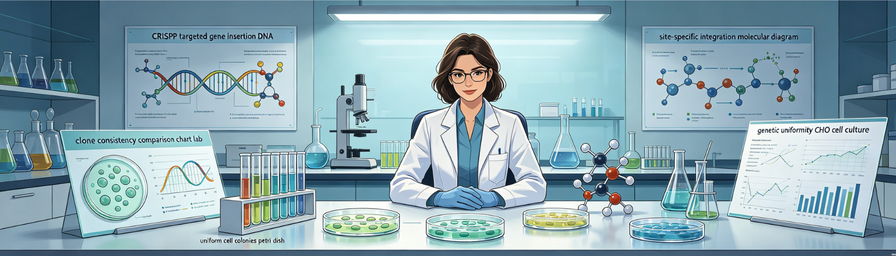
CRISPR site-specific integration uses the Cas9 endonuclease guided by a sequence-specific single guide RNA (sgRNA) to introduce a precise double-strand break at a predetermined genomic location. The expression cassette — containing the antibody gene flanked by homology arms matching the target locus — is then inserted at this specific site via homology-directed repair (HDR).
The target location is a validated genomic safe harbor: a transcriptionally active, stably maintained chromosomal address that supports robust expression and is far from essential genes or oncogenic regions. Because all successful integration events occur at the same locus, every resulting clone has the transgene in the same chromosomal context — eliminating the positional variation that drives clonal variability.
Not all CRISPR targeting sites are created equal. An ideal safe harbor locus must satisfy several criteria:
AntibodyLLM has validated multiple proprietary safe harbor sites in its CHO-K1 expression host through extensive genomic analysis and multi-passage stability testing. These loci are the foundation of our stable cell line development service.
Even in validated safe harbor loci, epigenetic silencing can gradually extinguish transgene expression during the extended culture periods required for biopharmaceutical manufacturing. Cells that stop expressing protein are not immediately eliminated by selection, and over many passages, the proportion of silenced cells in the population increases — causing production yields to decline in late-stage manufacturing campaigns.
Ubiquitous chromatin opening elements (UCOEs) solve this problem. Derived from the promoters of constitutively expressed housekeeping genes, UCOEs carry dense CpG islands that actively resist DNA methylation and maintain open, accessible chromatin in their vicinity. When UCOEs flank the integrated antibody expression cassette, they create a persistent chromatin-opening environment that prevents epigenetic silencing regardless of passage number.
AntibodyLLM's CRISPR CHO platform integrates UCOE elements flanking every expression cassette. In stability studies conducted over 60+ passages — equivalent to a full manufacturing campaign — our cell lines show less than 10% variation in specific productivity (qp), meeting ICH Q5D guidelines for cell line stability without exception. Learn more about our UCOE stable expression platform.
The practical benefits of site-specific integration are measurable at every stage of cell line development:
For therapeutic antibodies progressing toward clinical development, the regulatory implications of cell line development strategy are significant. Regulatory agencies (FDA, EMA) require demonstration of cell line stability and characterization of the integration site for IND/BLA submissions. CRISPR site-specific integration provides inherent advantages in this context:
Our stable cell line development service integrates CRISPR site-specific integration with UCOE anti-silencing technology in a single, streamlined workflow:
Clonal variability is not an unavoidable cost of stable cell line development — it is a solvable engineering problem. CRISPR site-specific integration, combined with UCOE anti-silencing technology, converts an unpredictable screening lottery into a deterministic, predictable process. The result is faster timelines, higher expression yields, and greater confidence in the stability of your production cell line.
Get a stable, high-expressing CHO cell line in 3–5 months with our CRISPR + UCOE platform.
Request a Quote