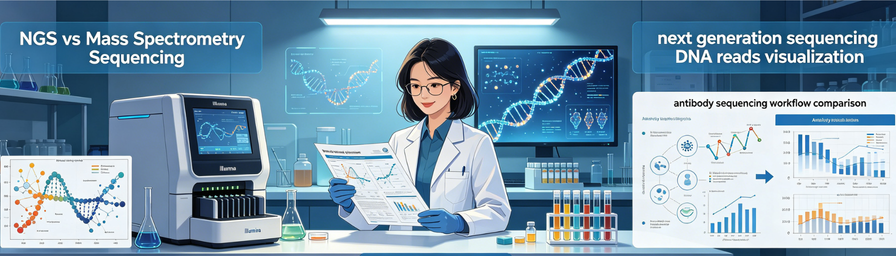
Antibody sequencing determines the amino acid sequence of an antibody — the molecular blueprint that defines its specificity, affinity, and therapeutic potential. Two technologies dominate modern antibody sequencing: Next-Generation Sequencing (NGS), which reads the DNA or RNA encoding the antibody, and mass spectrometry, which directly analyzes the protein itself. Choosing between them is not about which is "better" — it is about which answers your specific question. This guide provides a practical, data-driven comparison of both approaches.
Antibody sequencing is the process of determining the complete amino acid sequence of an antibody's variable regions — the heavy chain (VH) and light chain (VL) domains that contain the complementarity-determining regions (CDRs) responsible for antigen binding. Knowing the sequence enables recombinant antibody production, humanization design, affinity maturation engineering, intellectual property filings, and regulatory submissions.
Historically, Edman degradation — a chemical method developed by Pehr Edman in 1950 — was the only option. It was slow (weeks per antibody), required large amounts of purified protein, and struggled with modified amino acids. The landscape changed in the 2000s with the convergence of high-throughput DNA sequencing and high-resolution mass spectrometry, each offering fundamentally different approaches to answering the same question: "What is this antibody's sequence?"
NGS antibody sequencing starts with genetic material. Total RNA is extracted from B cells or hybridomas, converted to cDNA via reverse transcription, and amplified using primers targeting the conserved framework regions flanking VH and VL domains. The amplified products are then sequenced on Illumina (MiSeq or NovaSeq), Ion Torrent, or PacBio platforms.
The resulting reads — typically 100,000 to 5,000,000 per sample — are processed through bioinformatics pipelines: quality filtering, V(D)J gene assignment using IMGT or IgBLAST databases, CDR3 identification, clonotype clustering, and consensus sequence assembly. For monoclonal antibodies from hybridomas, this yields a single dominant VH and VL sequence. For polyclonal repertoires, the output is a landscape of clonal frequencies and sequence diversity.
The fundamental strength of NGS is throughput and resolution. A single run can profile thousands of B cells across multiple samples simultaneously, capturing the full breadth of an immune repertoire. Platforms like 10x Genomics extend this to single-cell resolution, pairing heavy and light chains from individual B cells at scale.
NGS does have limitations worth understanding. The method depends entirely on the availability and quality of genetic material — degraded RNA, formalin-fixed samples, or hybridoma cultures that have lost antibody expression render NGS ineffective. PCR amplification can introduce biases that distort clonal abundance estimates, particularly for rare clones. Primer design for non-model organisms often requires iterative optimization, as conserved framework regions in mice and humans may not align with rabbit, chicken, or camelid antibody genes. And critically, NGS provides no information about post-translational modifications — glycosylation patterns, oxidation states, and deamidation rates are invisible to DNA sequencing.
Mass spectrometry antibody sequencing works directly on the protein, bypassing the need for genetic material entirely. The workflow begins with purified antibody that undergoes reduction (breaking disulfide bonds), alkylation (blocking free cysteines), and digestion with multiple proteases (trypsin, chymotrypsin, Asp-N, Lys-C, and Glu-C). Each enzyme cleaves at different amino acid residues, generating overlapping peptide fragments that collectively cover the entire sequence.
These peptide mixtures are separated by liquid chromatography (LC) and analyzed by tandem mass spectrometry (MS/MS). In an Orbitrap mass spectrometer — the gold standard instrument — peptides are first measured intact (MS1), then fragmented by collision-induced dissociation (CID) or higher-energy collisional dissociation (HCD), and the fragment masses are measured again (MS2). The resulting MS/MS spectra reveal the amino acid sequence one residue at a time, like reading a molecular barcode.
The choice of instrument matters significantly. Orbitrap-based instruments (Thermo Fisher Q Exactive, Orbitrap Eclipse, Orbitrap Astral) provide the mass accuracy (<1 ppm) and resolution (>140,000) needed to distinguish isobaric amino acids — residues with identical or near-identical masses, such as leucine and isoleucine (both 113.084 Da). The newer timsTOF instruments (Bruker) add ion mobility separation as a fourth dimension, resolving peptides that co-elute from the LC column. For antibody sequencing, this additional separation significantly improves coverage of the CDR regions, which often contain unusual amino acid compositions that produce challenging fragmentation patterns.
For antibodies with known germline genes, database-dependent searching using tools like Mascot, MaxQuant, or Byonic can identify the sequence by matching spectra to predicted peptides. For antibodies of unknown origin — lost hybridoma documentation, unsequenced species, novel scaffolds — de novo sequencing algorithms (PEAKS, pNovo 3, Novor) reconstruct the sequence from spectral data alone, without any reference database. This is the definitive approach for truly unknown antibody sequences, though it requires 3–6 protease digests and reaches >95% sequence coverage on modern instruments.
| Dimension | NGS | Mass Spectrometry |
|---|---|---|
| Starting material | DNA or RNA (1–10 ng) | Purified protein (10–100 µg) |
| Turnaround time | 1–3 days | 1–4 weeks |
| Throughput | Thousands of clones/sample | One antibody at a time |
| De novo capability | Limited (needs reference) | Yes — full de novo possible |
| Accuracy | >99.9% (with error correction) | >95% sequence coverage (Orbitrap) |
| PTM detection | Indirect (requires translation) | Direct — glycosylation, oxidation, etc. |
| Cost per mAb | $200–$800 | $3,000–$8,000 (de novo) |
De novo sequencing — determining a complete amino acid sequence without any reference database — is where mass spectrometry has no NGS equivalent. Modern de novo workflows combine multiple orthogonal proteases (trypsin, chymotrypsin, Asp-N, Glu-C, Lys-C) to generate overlapping peptides, run each digest on a high-resolution Orbitrap or timsTOF instrument, and assemble sequences using algorithms like PEAKS AB or pNovo 3 that incorporate antibody-specific knowledge (CDR length constraints, conserved framework residues, canonical disulfide patterns).
The technology has advanced significantly. In 2024, a landmark study demonstrated 99% sequence coverage for all six CDR loops in a set of 12 monoclonal antibodies using a multi-protease Orbitrap workflow, with 100% accuracy for CDR3 sequences — the most critical region for antigen binding. This level of performance has made mass spectrometry a viable primary approach for antibody sequencing, not just a backup.
At AntibodyLLM, our antibody discovery and sequencing services integrate both NGS and mass spectrometry into a unified platform that selects the optimal method based on sample type, project goals, and regulatory requirements.
The most robust sequencing strategies combine both technologies for complementary strengths. A typical integrated workflow starts with mass spectrometry de novo sequencing to determine the full protein sequence, followed by back-translation to design codon-optimized genes for recombinant expression. NGS is then used to confirm the synthesized gene sequence, close any remaining gaps through primer walking, and verify expression fidelity.
This dual approach is particularly valuable for antibody humanization programs, where the starting murine sequence is obtained by mass spectrometry, the humanization design is performed computationally using our AI antibody design service, and the final humanized sequence is verified by both NGS and targeted MS/MS.
The cost-benefit analysis for integrated approaches has shifted dramatically in the last five years. Where a full NGS + MS workflow once cost $15,000–$25,000 per antibody a decade ago, competitive providers now deliver the same at $4,000–$10,000. For lead therapeutic candidates heading toward IND filing — where regulatory reviewers expect comprehensive characterization — the incremental cost of adding mass spectrometry to an NGS workflow (roughly $3,000–$6,000) is negligible compared to the cost of a clinical hold due to insufficient characterization. The question has evolved from "Can we afford integrated sequencing?" to "Can we afford not to?" for programs approaching regulatory milestones.
Selecting an antibody sequencing provider requires evaluating more than just the technology. Key considerations include: demonstrated success with antibody-specific samples (not generic proteomics), transparent reporting of sequence coverage and confidence metrics, experience with your antibody format (IgG, IgM, bispecific, nanobody), ISO 9001 or GLP compliance for regulated programs, and turnaround time guarantees with contingency plans for difficult sequences.
Ask providers about their CDR coverage rate specifically — not overall sequence coverage. A 95% overall coverage rate is meaningless if the missing 5% includes CDR3 residues. The best providers report per-CDR coverage and provide raw data files (FASTQ for NGS, RAW/.mzML for MS) that can be independently re-analyzed.
The sequencing landscape continues to evolve rapidly. Long-read sequencing platforms (PacBio Revio, Oxford Nanopore PromethION) now deliver full-length antibody transcripts spanning the entire V(D)J region in a single continuous read, eliminating the assembly step required by short-read Illumina platforms. This is particularly valuable for antibodies with unusually long CDR3 loops (above 24 amino acids) that challenge short-read assembly algorithms. On the mass spectrometry side, the emergence of ion mobility-enabled instruments (timsTOF, FAIMS) adds an additional separation dimension that significantly improves coverage of CDR regions — historically the most challenging part of the antibody to sequence by MS. For programs planning sequencing work 12–18 months out, these emerging capabilities should factor into partner selection.
For most antibody programs, NGS is the default starting point: fast, affordable, and sufficient for monoclonal hybridomas with available genetic material. Choose mass spectrometry when genetic material is lost, when working with unsequenced species, when post-translational modifications matter, or when regulatory or IP considerations demand protein-level sequence confirmation. For comprehensive characterization — particularly of lead candidates moving toward IND filing — invest in both technologies for orthogonal validation that leaves no ambiguity.
Antibody sequencing is no longer a binary choice between methods. It is a strategic decision about what information matters most for your program — and increasingly, the answer is: get the complete picture.
NGS sequences the DNA or RNA encoding the antibody, providing nucleotide-level data and enabling clonal diversity analysis. Mass spectrometry directly sequences the antibody protein at the amino acid level through peptide digestion and LC-MS/MS analysis. NGS requires genetic material and database matching; mass spectrometry works directly on protein without prior genetic information, enabling true de novo sequencing of unknown antibodies. The methods are complementary: NGS excels at throughput and repertoire analysis, while mass spectrometry provides direct protein-level sequence confirmation and post-translational modification detection.
Mass spectrometry can sequence most monoclonal antibodies, including those from species with poorly characterized genomes, hybridomas of unknown origin, and antibodies where genetic material has been lost. Challenges include extremely complex mixtures (polyclonal antibody pools), antibodies with extensive post-translational modifications, and very low-abundance samples below sensitivity thresholds. Modern high-resolution instruments like Orbitrap and timsTOF can achieve >95% sequence coverage for full-length heavy and light chains, with limited applicability to polyclonal mixtures.
NGS antibody sequencing achieves >99% base-call accuracy with Illumina platforms, reaching >99.9% with barcode-based error correction. Accuracy depends on the quality of starting DNA or RNA template; PCR amplification bias can distort clonal frequencies, and RNA-based approaches miss non-expressed alleles. For monoclonal hybridomas, NGS is extremely reliable. Single-cell approaches like 10x Genomics achieve >90% paired VH-VL recovery rates. Bioinformatics processing with IMGT/HighV-QUEST or MiXCR provides additional quality checks on CDR3 identification and V(D)J gene assignment.
De novo antibody sequencing determines the complete amino acid sequence without any prior knowledge of the genetic sequence. Unlike database-dependent methods that match MS/MS spectra against reference proteomes, de novo sequencing derives the peptide sequence directly from fragmentation spectra using computational algorithms (PEAKS, pNovo, Novor). This approach is essential for antibodies from unsequenced species, proprietary hybridomas with lost documentation, or drug candidates requiring independent sequence verification. Modern multi-protease workflows on Orbitrap instruments achieve >95% sequence coverage and >99% CDR3 accuracy.
NGS is the faster method: a complete VH/VL region can be sequenced and assembled in 1–3 days, including library preparation, sequencing, and bioinformatics analysis. Mass spectrometry requires more extensive sample preparation (denaturation, reduction, alkylation, multi-enzyme digestion), multiple LC-MS/MS runs (typically 3–6 protease digests), and computationally intensive de novo assembly, requiring 1–4 weeks for a complete monoclonal antibody sequence. For high-throughput screening or time-sensitive discovery programs, NGS provides the shortest turnaround.
NGS-based VH/VL sequencing costs $200–$800 per monoclonal antibody, with repertoire sequencing at $1,000–$3,000 per sample. Mass spectrometry de novo sequencing costs $3,000–$8,000 for a complete antibody (heavy + light chain), depending on sequence complexity and required coverage. Database-dependent MS sequencing (where reference sequence exists) costs $500–$1,500. The higher MS cost reflects longer instrument time per sample, multi-enzyme digestion protocols, and specialized computational analysis. Most discovery programs use NGS as the primary method, reserving MS for specific validation needs.
Mass spectrometry directly identifies post-translational modifications including glycosylation, N-terminal pyroglutamate formation, C-terminal lysine clipping, methionine oxidation, asparagine deamidation, and disulfide bond patterns. Each modification produces a characteristic mass shift detectable by high-resolution MS. NGS cannot directly detect PTMs since it reads only the genetic template. For therapeutic antibodies where glycosylation profiles, oxidation levels, and deamidation rates are critical quality attributes, mass spectrometry-based peptide mapping is the regulatory standard mandated by FDA and EMA guidelines for characterization and comparability studies.
Tell us about your antibody — we will recommend the optimal sequencing strategy for your program, whether NGS, mass spectrometry, or an integrated approach.
Start Your Sequencing Project