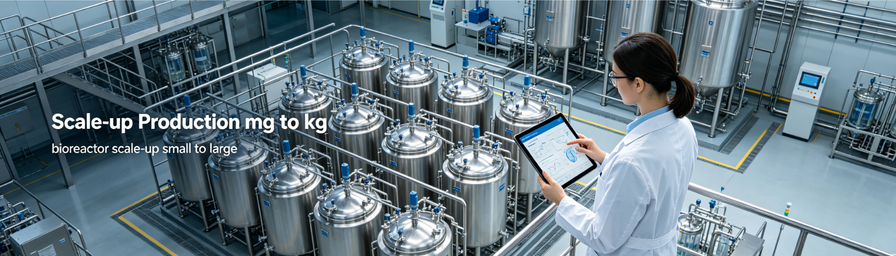
A milligram of recombinant antibody is enough to run initial binding assays. A gram supports early preclinical studies. A kilogram enables Phase I/II clinical trials and early commercial supply. But the path from a 50mL shake flask to a 1,000L bioreactor is not linear — each jump in scale introduces new engineering challenges that can silently alter the product quality that defined your early-stage data. This guide covers what changes at scale, what to watch for, and how to design your production strategy to arrive at kg quantities without compromising the antibody that got you there.
Recombinant antibody production typically progresses through discrete scale stages, each with a different purpose:
Each transition requires deliberate process development — not just a volume increase. The variables that drive this complexity fall into three categories: upstream bioprocess, downstream purification, and product quality analytics.
CHO cells require dissolved oxygen (DO) maintained at 30–50% air saturation. At small scale, surface aeration is sufficient. At production scale, sparger-based aeration is required, introducing foam formation and shear stress from bubbles — both of which can damage cells and alter product quality. The volumetric oxygen transfer coefficient (kLa) must be matched across scales, and sparger design, agitation rate, and gas composition (air/O2/CO2) must be reoptimized at each scale.
As bioreactor volume increases, dissolved CO2 (dCO2) accumulates due to reduced surface-to-volume ratio and reduced stripping efficiency. High pCO2 (>150 mmHg) elevates intracellular pH, reduces cell growth and productivity, and alters glycosylation — particularly sialylation and galactosylation of the Fc region. CO2 stripping through increased sparging and agitation must be balanced against cell damage. This is one of the most commonly underestimated scale-up failure modes.
Larger bioreactors have longer mixing times — the time for a nutrient bolus added to the top to mix uniformly throughout the vessel. Poor mixing creates concentration gradients in glucose, glutamine, pH, and DO, exposing cells to fluctuating microenvironments. Impeller speed (tip speed) must be controlled to provide sufficient mixing while avoiding hydrodynamic shear that damages fragile CHO cells.
Fed-batch feeding strategies developed at small scale rarely translate directly to large scale without adjustment. Nutrient depletion profiles, osmolality accumulation from feed addition, and pH drift patterns all change with scale. Process analytical technology (PAT) tools — online glucose/lactate analyzers, capacitance probes for biomass — enable real-time process control that compensates for these differences and maintains consistent cell culture performance regardless of scale.
Protein A affinity chromatography remains the standard first step for IgG purification, delivering >95% purity in a single step. At scale, resin lifetime (cycles per column), dynamic binding capacity utilization, and elution pool volume management become critical economic and quality drivers. Resin screening and lifetime validation studies should begin at pilot scale to inform GMP-scale column specification.
For clinical-grade material, the downstream process must demonstrate ≥4 log reduction in model viruses at each clearance step (typically Protein A low-pH hold, anion exchange, and nanofiltration). Scale-up of viral clearance steps requires demonstrating that clearance factors are maintained at production scale — a regulatory requirement documented in the viral clearance validation report.
Ion exchange and hydrophobic interaction chromatography steps that separate charge variants and aggregates at small scale must be re-optimized at production scale where column geometry changes alter peak resolution. Formulation development — selecting buffer, excipients, and protein concentration for stability in the final drug substance — should be initiated in parallel with scale-up to avoid late-stage surprises.
Critical quality attributes (CQAs) that must be monitored at each scale include:
Establishing CQA comparability between scales — demonstrating that the product made at 500L is analytically equivalent to the product from your 5L development runs — is the formal requirement for regulatory submissions. AntibodyLLM's monoclonal antibody production service includes a full analytical characterization package at each scale step to support comparability documentation.
The single most important determinant of scale-up success is the cell line. A genetically unstable, low-expressing cell line will underperform at scale just as it does at small scale — but now at far greater cost. A high-expressing, stable cell line built on CRISPR site-specific integration delivers consistent specific productivity (qp) regardless of bioreactor scale because the expression is driven by the cell's genomic programming, not by fragile episomal maintenance.
AntibodyLLM's stable cell line development platform uses CRISPR + UCOE technology to deliver production CHO cell lines with >3× improvement in volumetric titer compared to conventional random integration cell lines — providing more buffer against scale-up losses and a lower cost of goods at production scale.
Before committing to a scale-up strategy, answer these questions:
Our monoclonal antibody production service supports the full scale ladder from milligram feasibility through kilogram manufacturing:
Scaling from mg to kg is not a single leap — it is a series of deliberate engineering decisions, each of which either preserves or compromises the product quality that defines your antibody's clinical and commercial value. Starting with the right cell line, applying rigorous process characterization at each scale step, and monitoring CQAs continuously are the principles that separate successful scale-up programs from costly failures.
From mg feasibility to kg GMP manufacturing — talk to our team about your scale-up requirements.
Request a Quote